
Caching Patterns : Write Behind
Introduction
Write-behind caching is a key strategy in distributed systems for enhancing write efficiency and reducing latency. By caching write operations and deferring updates to the persistent storage, this approach minimizes write contention and optimizes resource utilization. It enables systems to handle high volumes of write operations by absorbing spikes in data flow, thereby improving the user experience with faster response times. Furthermore, by batching and asynchronously processing write operations, write-behind caching ensures more efficient use of network and storage resources, crucial for the scalability and performance of distributed architectures.
Mechanics of the pattern
Sequence diagram
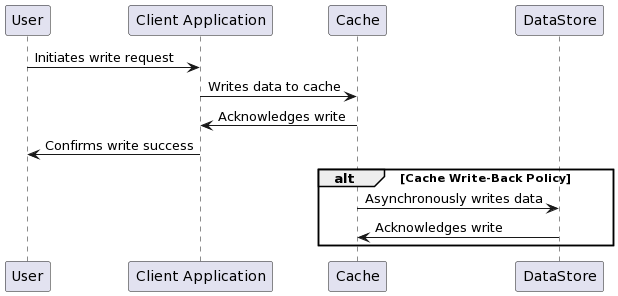
Steps
Here is a breakdown of the steps involved in the process :
- User initiates a write request to the Client Application.
- Client Application writes the data to the Cache.
- Cache acknowledges the write immediately to the Client Application.
- Client Application confirms the write success to the User.
- In the background, the Cache asynchronously writes the data to the DataStore. This write can be batched with other writes to enhance write performance to the data store.
- DataStore acknowledges the write to the Cache.
Implementation
The following diagram showcases an implementation of the write behind strategy on AWS. It leverages the use of a queuing system to perform the asynchronous write to the data store :
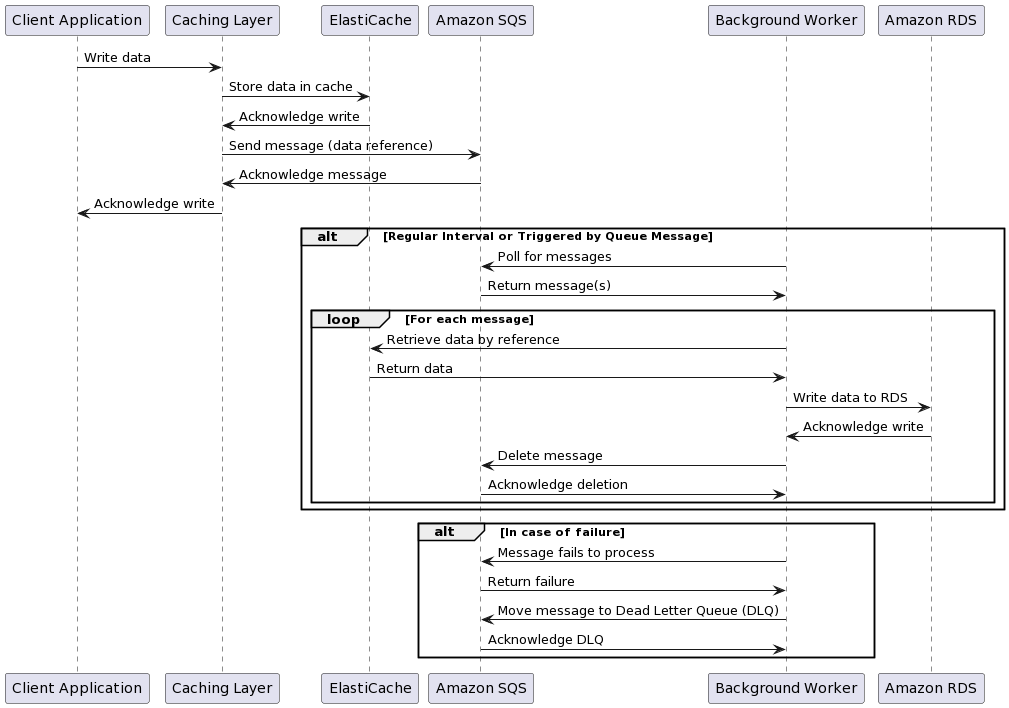
For more details on the implementation of this system you can view the following post :
Conclusion
Write-behind caching is a pivotal pattern for enhancing the performance and scalability of distributed systems. By allowing write operations to be collected and processed asynchronously, this approach significantly reduces the write latency perceived by users, leading to a smoother and more responsive application experience. It also optimally utilizes system resources by minimizing the immediate load on persistent storage systems and reducing network overhead through batched write operations.