
Tequiz: Technical Interview Preparation
Introduction
I’ve always believed that AWS offer immense power and scalability to build versatile applications. Today, I am excited to share with you one such application I’ve built, inspired by the countless professionals aiming to ace their technical interviews. Presenting, the Ultimate Technical Interview Prep Application for software engineers, DevOps engineers, and cloud engineers!
Tequiz
Technical interviews can be daunting. They not only require a grasp over algorithms and coding but also a deep understanding of system designs, deployment strategies, and cloud architectures. Tequiz is designed to test :
- Foundational knowledge : Dive deep into the essentials of software and platform engineering.
- Tech integration mastery : Learn how to seamlessly combine different services, platforms, and tools to solve real-world problems.
Architecture
In my commitment to transparency and education, I am excited to give you an insider’s look at the very backbone of the application - its architecture. By sharing this, I aim to provide insights into the design and deployment of scalable and resilient cloud-based applications.
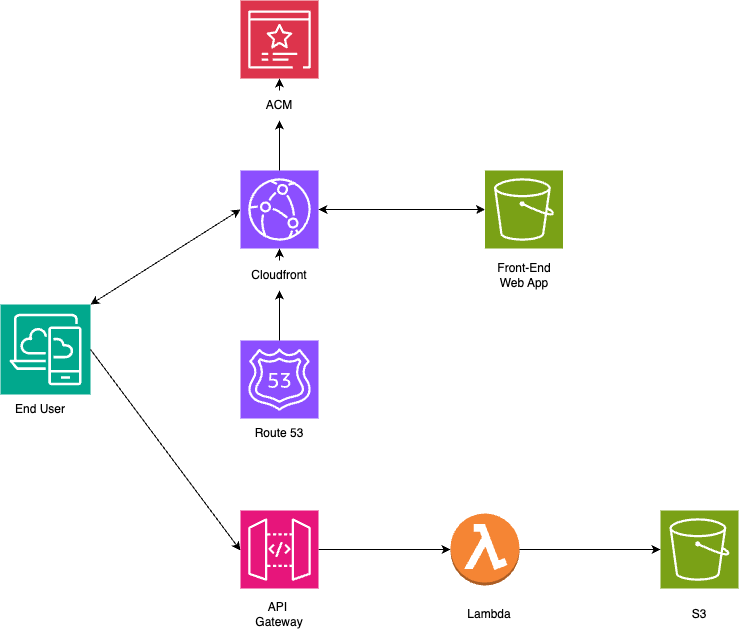
AWS Architecture
Front End Components
S3
Amazon S3, or Simple Storage Service, is a storage service that is used to store large files. In this case it contains the build artifacts of the tequiz Front End (html, css, js, images, …)
CloudFront
Amazon CloudFront is a Content Delivery Network (CDN). It serves the content of the S3 bucket globally. In this case it takes the site’s content and distributes it to a network of servers around the world. This ensures that users can load the website quickly around the globe.
Route 53
Amazon Route 53 is a scalable DNS service. In this case it helps resolve the company’s domain name to the cloudfront IP addresses.
ACM
ACM, or AWS Certificate Manager, allows to manage/generate SSL/TLS certificates. These certificates ensure the data between the Tequiz website and its visitors remain encrypted and secure.
Back End Components
API Gateway
Amazon API Gateway is a fully managed service that makes it easy for developers to create, publish, maintain, monitor, and secure APIs at any scale. For Tequiz, API Gateway serves as the doorway to access quiz data, allowing frontend applications to communicate with the backend.
Lambda
AWS Lambda is a serverless computing service that lets you run code without provisioning or managing servers. When a specific quiz endpoint is accessed via the API Gateway in the Tequiz application, Lambda functions are triggered. These functions fetch the required quiz data, process it, and return the results to the frontend.
S3
S3 is used to store quiz data (json files). In the realm of cloud architecture, decisions are often a balance between performance, scalability, and cost. For Tequiz, storing the actual quiz data on Amazon S3 was a conscious choice rooted in cost optimization. While there are various data storage solutions available on AWS, S3 presented a cost-effective yet highly reliable option for the current needs.
Software design considerations
Lazy loading caching pattern
To further enhance the performance and cost-effectiveness of Tequiz, I’ve implemented lazy loading in the Lambda functions.
Lazy loading is a technique where the quiz data is fetched from S3 only once when the Lambda function is invoked for the first time. For subsequent calls, instead of fetching again S3, the data is quickly retrieved from Lambda’s memory, resulting in significantly faster response times.
The benefits are twofold:
- Cost Reduction: By minimizing calls to S3, request costs are significantly cut down.
- Enhanced Speed: Fetching data from memory is almost always faster than fetching it from an external source. This ensures users get snappy responses when using the application
Conclusion
Navigating the vast ecosystem of AWS services to architect a performant and cost-effective application can be quite the journey. Through Tequizz, we’ve not only managed to create a robust platform for technical interview preparation but have also strived to make informed architectural choices at every step. Our dedication to cost optimization, performance, and user experience remains unwavering.
While we’ve touched upon the intricacies of our AWS architecture and the efficiency brought in by lazy loading in this post, the world of caching mechanisms is vast and worth exploring further. If you’re curious about diving deeper into lazy loading and understanding other caching strategies that can amplify application performance, I invite you to read my detailed article on caching mechanisms. It’s essential to continually evolve our understanding, and I’m thrilled to be a part of this shared learning journey.